Talking statistics around fertility

When we fell pregnant I never expected that statistics and mathematics would play such a part in my life and subsequent grief. I hated maths in school and never thought it would affect my life or that I would require it that much as my career progressed.
We are surrounded by statistics everyday whether it’s reported on the news, in an article we are reading or in an advert. I had never really paid much attention to them until I became one of the 1 in 4 women who suffer a pregnancy loss. Subsequently from our loss of Kora and Ava and through our fertility journey we seemed to be consumed with percentages and statistics.
When we fell pregnant with MCMA (monochoronic monoamniotic) twins we were unaware what this meant. The sonographer moved from one side where we had seen a beautiful baby to the other saying “There is one heartbeat and there is the other”. She explained that they were identical twins and appeared to be sharing a sac. We were marked down as a high risk pregnancy and told we would be scanned every two weeks.
This was as much information as we were given. I assumed we were high risk as it was a multiple birth. However I could not help but research a little further more about MCMA twins.
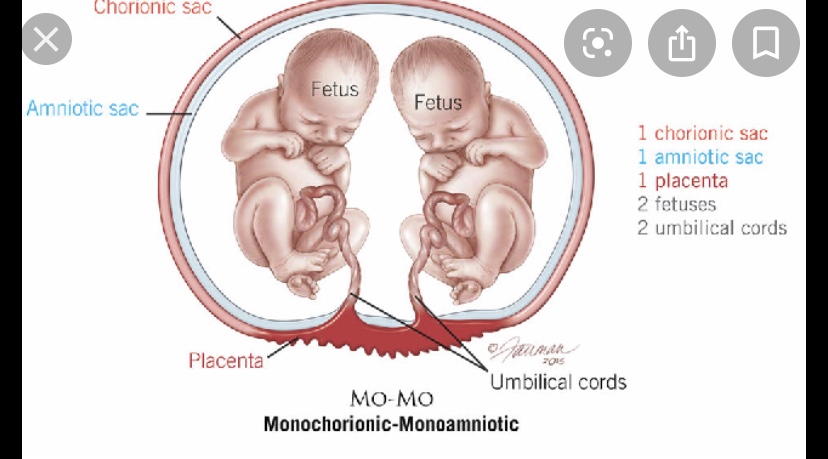
Here comes the next statistic… only 1% of twins are MCMA. What I discovered is that they had more risks than other twin pregnancies. Mainly as they were sharing the placenta there was a risk of undernourishment of one twin resulting in other complications. However our scan showed that they were both growing at the same rate and had only 1cm difference in size.
My mind felt put to rest. I had read some wonderful success stories of MCMA twins and I felt I should remain positive as I was the one carrying them and I didn’t want to impact my babies with stress or worry that could be very unnecessary.
Our first scan had been delayed and we had actually been scanned at 13 weeks and 3 days. Our next scan should have been in 2 weeks but was also delayed and we had it at 16 weeks and 4 days. I remember Neil asking me if I was nervous but I told him I felt excited. He had been telling me how worried he was as they had said high risk. If I had to describe myself I would say I am a realist with optimistic tendencies. I had heard the high risk, I had researched the possible outcomes or implications but I also felt hopeful.
We were told on this scan that our babies had no heartbeats. It was the devastating news I had not expected but Neil had worried about. We were taken into a room and in automatic mode I swallowed a pill to end our pregnancy. We were asked to return two days later to start the induction of labour.
Labour however had different ideas to the medical professionals. Here is our next statistic… I was the 1 in 60,000 women that induction doesn’t seem to work. We were in hospital for 10 days before I delivered Kora and Ava. I can’t even find the words or feelings today to explain how difficult it is to walk around with your babies still looking very pregnant but knowing they have passed away inside you.
I later found out that the survival rates of MCMA twins is 50% which is a statistic I would happily bet on. I like the odd flutter and would always bet on black or red on the roulette table with the odds at 50%.
This is not the end of the statistics! Neil and I then became the couple that struggle to conceive. We fell pregnant again nearly one year on in 2019 but had a biochemistry miscarriage just 2 days after finding out we were pregnant. Again we fell into the 1 in 4.
We then started our IVF journey and in November 2019 we started the injections. In December our two week wait to take the pregnancy test came to an abrupt end two days before our official test date. It was assumed that it had not worked due to a very heavy bleed. However we had in fact been successful with twins again. We had what is known as a heterotopic pregnancy. It is (of course) a rare complication in pregnancy in which both extra-uterine (ectopic pregnancy) and intrauterine pregnancy occur simultaneously. It may also be referred to as a combined ectopic pregnancy, multiple‑sited pregnancy, or coincident pregnancy.
So for the next statistic only 1 in 70,000 pregnancies are heterotopic. With 1% of IVF pregnancies resulting in this type of pregnancy. However as Neil and I had no underlying medical conditions such as polycystic ovary syndrome or endometriosis it was obviously considered a very low risk for us.
Comments I have become used to hearing are “it could only happen to you” or “it’s just your luck” or my least favourite “you have such bad luck”. I am unsure if these are positive or negative comments. I don’t find them very useful but I again understand that people often don’t know what to say or pass a comment without thinking too much about it.

Let’s turn these statistics around! Women at my age (38-40) undergoing IVF have only a 5.3% chance of having twins. I was lucky to be in that percentage. Our first round with one fresh and one frozen embryo which resulted in twins. Between the ages of 38-40 there is only a 38% chance of getting pregnant via IVF. We also managed to be in this statistic. To conceive naturally in between these ages during ovulation there is a 29% chance as fertility decreases at 35 and decreases rapidly after 37.
Only 1 in 250 people are fortunate enough to have identical twins and it was Neil and I that fell pregnant with our daughters Kora and Ava at the age of 38 when fertility is decreasing.
So I conclude by saying that I feel lucky. I have fallen pregnant and been blessed to know what that is like. I have experienced labour and delivered our identical twins Kora and Ava. I am so grateful that Neil gave this to me. As difficult as the IVF journey was due to complications and a roller coaster of emotions we were fortunate enough that both embryos implanted (albeit one in the wrong place) on our first round. Many people have IVF and go through many rounds. We were lucky to get a good number of eggs and for them to last till day 5 and be of a good/high quality. This gives us more opportunities to try again.
I also told my consultant that I am starting to play the lottery as I seem to fall into the lower odds and being positive I’m sure one day the odds will most definitely be in my/our favour!
 Stars in the Sky